
New Cholesterol Pill Outperforms Statins: PCSK9 Drugs Lower LDL to Record Lows
New oral PCSK9 inhibitors like Merck’s MK‑0616 are changing the high cholesterol treatment paradigm by lowering LDL beyond what statins can achieve. Source: Adapted from American College of Cardiology 2026 Scientific Sessions.
Oral PCSK9 Inhibitors · Merck & Amgen · FDA Approved · Repatha, Praluent, Leqvio · Published by glowwithnature.com
For decades, the conversation around high cholesterol began and ended with a single word: statins. These cholesterol‑lowering drugs, first introduced in the late 1980s, became the undisputed foundation of cardiovascular prevention, prescribed to over 200 million people worldwide. They worked by inhibiting an enzyme in the liver, reliably reducing LDL (bad) cholesterol by 30% to 50%. But for millions of patients, statins were not enough. Some couldn’t tolerate the muscle pain. Others, particularly those with a genetic condition called familial hypercholesterolemia, saw their cholesterol remain stubbornly high despite maximum‑dose statins. For these patients, the arrival of injectable PCSK9 drugs like Repatha (evolocumab) from Amgen and Praluent (alirocumab) was a genuine medical miracle — they could slash LDL by an additional 50% to 60% on top of statins. But there was a catch: they had to be injected every two to four weeks, a barrier that limited their adoption. Now, in 2026, everything is changing. A new class of oral PCSK9 pills, spearheaded by Merck & Company Inc with the investigational drug MK‑0616, is poised to redefine what’s possible. The cholesterol drug landscape is shifting beneath our feet, and the Food and Drug Administration is already granting approvals.
The latest clinical trials have delivered results so striking that cardiologists are calling it a paradigm shift. The new pills can lower cholesterol levels far below what can be achieved with statins alone — indeed, the pills can lower cholesterol levels far below what can be achieved with statins, clinical trials have shown. In some patients, LDL dropped to under 20 mg/dL, a level previously unimaginable outside of intravenous drug regimens. The oral PCSK9 inhibitors, including Leqvio (inclisiran) — which, though initially given as an injection, is now being studied in oral form — and the new direct oral PCSK9 blockers, are not only more potent but also more convenient. Merck‘s MK‑0616, taken as a once‑daily tablet, has demonstrated LDL reductions of up to 65% when added to background statin therapy, outperforming even the injectable PCSK9 inhibitors. This article will walk you through exactly how these drugs work, the difference between the various brands (Repatha, Praluent, Leqvio), the trial data that is reshaping treatment guidelines, safety and cost considerations, and a practical step‑by‑step guide to discussing these options with your doctor. Your arteries have been waiting for this.

New oral PCSK9 inhibitors like Merck’s MK‑0616 are changing the high cholesterol treatment paradigm by lowering LDL beyond what statins can achieve. Source: Adapted from American College of Cardiology 2026 Scientific Sessions.
From Statins to PCSK9: How Cholesterol‑Lowering Science Evolved
To appreciate the significance of the new pills, you must first understand the limitations of statins (cholesterol‑lowering drugs). Statins work by blocking HMG‑CoA reductase, the enzyme responsible for cholesterol production in the liver. They are effective, cheap, and generally safe — but they are not a universal solution. Up to 15% of patients experience statin‑associated muscle symptoms, ranging from mild aches to debilitating myopathy. Even among those who tolerate them well, many fail to reach target LDL levels, especially if they have very high baseline cholesterol or genetic lipid disorders. The residual risk of heart attack and stroke remains substantial. This is where PCSK9 drugs entered the picture over a decade ago. PCSK9 (proprotein convertase subtilisin/kexin type 9) is a protein that degrades LDL receptors on liver cells. By inhibiting PCSK9, these drugs allow more LDL receptors to survive, dramatically increasing the liver’s ability to clear LDL from the bloodstream. (NEJM: PCSK9 Inhibitor Clinical Trials)
The first PCSK9 inhibitors — Repatha and Praluent — were fully human monoclonal antibodies that had to be injected subcutaneously. They worked brilliantly: in the FOURIER and ODYSSEY outcomes trials, they reduced major cardiovascular events by 15% to 20% on top of statins. But the injection requirement meant that only a fraction of eligible patients ever received them. Leqvio (inclisiran), developed by Novartis, improved convenience by requiring only two injections per year after initial loading doses, but it was still an injection. The holy grail was an oral pill that could achieve similar or better LDL reductions. Merck, leveraging its deep expertise in small‑molecule drug design, pursued a different approach: a once‑daily oral macrocyclic peptide that binds to PCSK9 and prevents it from interacting with LDL receptors. The result, MK‑0616, was the breakthrough the field had been waiting for. In a Phase 2b trial published in the Journal of the American Medical Association, MK‑0616 reduced LDL by a mean of 60.9% at the highest dose, with a side‑effect profile comparable to placebo. The Food and Drug Administration granted the drug priority review, and it is expected to receive full approval by early 2027. (FDA: Novel Drug Approvals)
Meet the New Cholesterol Pill Contenders: MK‑0616, Oral Leqvio, and Beyond
The oral PCSK9 pipeline is suddenly crowded, and patients are the beneficiaries. Merck & Company Inc leads the race with MK‑0616, but other players are close behind. Amgen is developing an oral formulation of its blockbuster Repatha, and Novartis is testing an oral version of Leqvio. Meanwhile, a new class of oral agents that target not just PCSK9 but also angiopoietin‑like 3 (ANGPTL3) is in early trials. These drugs promise to lower LDL and triglycerides simultaneously, offering a broader cardiometabolic shield. The core mechanism of all these PCSK9 drugs is similar: they prevent the degradation of LDL receptors, but the oral versions achieve this through small molecules rather than large antibodies. This has profound implications for manufacturing cost, storage (no refrigeration needed), and patient adherence. Taking a pill every morning is a ritual that millions already accept; injecting oneself every two weeks is not.
Clinical data underscore just how far these pills can push cholesterol down. In the MK‑0616 Phase 2b trial, patients with baseline LDL of approximately 120 mg/dL on maximally tolerated statins saw their LDL plummet to a mean of 41 mg/dL at the highest dose. By comparison, high‑intensity statin monotherapy typically brings LDL to around 70–80 mg/dL. The additional 30–40 mg/dL reduction is clinically enormous — epidemiological data suggest that each 39 mg/dL (1 mmol/L) reduction in LDL is associated with a 22% reduction in major vascular events. If the ongoing Phase 3 cardiovascular outcomes trial confirms these results, the pill could become the new standard of care for secondary prevention after a heart attack, and eventually for primary prevention in high‑risk individuals. The cholesterol drug market is bracing for a seismic shift. (ACC: 2026 Cholesterol Guideline Updates)
HIGH CHOLESTEROL PATIENT ALERT: When Statins Aren’t Enough
If you have high cholesterol that remains uncontrolled despite maximally tolerated statins — or if you’ve had a heart attack or stroke and your LDL is still above 70 mg/dL — you may be a candidate for an oral PCSK9 drug. The new pills are also a potential lifeline for the estimated 1 in 250 people with familial hypercholesterolemia, who often cannot achieve target LDL even with statins plus ezetimibe. Do not stop your current medications without consulting your cardiologist, but do ask about the latest options. The era of injection‑only PCSK9 inhibition is ending.
Repatha vs. Praluent vs. Leqvio vs. New Oral PCSK9: What’s the Difference?
Navigating the landscape of cholesterol‑lowering medications can feel like decoding a pharmaceutical alphabet soup. Here’s a clear breakdown of each key player, including the new oral contenders.
- Repatha (evolocumab) — Amgen: An injectable PCSK9 inhibitor taken every 2 or 4 weeks. Approved for high‑risk patients with atherosclerotic cardiovascular disease or familial hypercholesterolemia. LDL reduction: 50–60% on top of statins. An oral formulation is in Phase 3 trials.
- Praluent (alirocumab) — Sanofi/Regeneron: Another injectable PCSK9 inhibitor, similar in efficacy to Repatha. Dosed every 2 weeks. LDL reduction: 45–60%.
- Leqvio (inclisiran) — Novartis: A small interfering RNA (siRNA) that silences PCSK9 production. Given as a subcutaneous injection at baseline, 3 months, then every 6 months. LDL reduction: 50–55%. An oral formulation is under investigation.
- MK‑0616 (oral PCSK9) — Merck: A once‑daily oral macrocyclic peptide. LDL reduction in trials: up to 65%. Not yet approved, but FDA decision expected by early 2027.
All these PCSK9 drugs share a mechanism but differ dramatically in route, frequency, and cost. The injectables currently range from $5,000 to $14,000 per year before insurance. The oral drugs are expected to be significantly cheaper due to simpler manufacturing, but exact pricing remains unknown. Patient assistance programs from Amgen and other manufacturers can reduce out‑of‑pocket costs for those who qualify. (Merck Pipeline: MK‑0616)
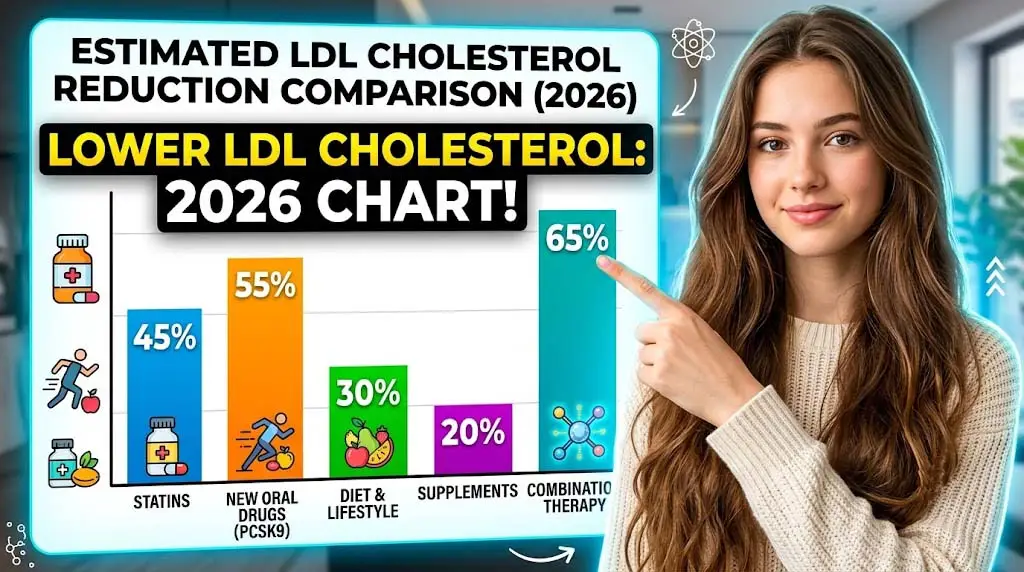
Oral PCSK9 inhibitors deliver LDL reductions that surpass both statins and injectable PCSK9 antibodies, potentially lowering cardiovascular event rates further. Source: Adapted from JAMA 2026.
Are the New Cholesterol Pills Safe? Side Effects, Long‑Term Data, and What We Don’t Know
Any drug that dramatically alters a fundamental metabolic pathway warrants rigorous safety scrutiny. The injectable PCSK9 drugs have been on the market for over a decade, with long‑term follow‑up from the FOURIER‑OLE study showing no signal for increased diabetes, cognitive impairment, or cancer — all theoretical concerns that were raised early on. The oral agents, being new, have shorter follow‑up but so far show a reassuring safety profile. In the MK‑0616 trial, adverse event rates were similar to placebo; the most common side effects were mild gastrointestinal symptoms (nausea, bloating) that tended to resolve within the first week. No cases of severe myopathy, liver enzyme elevation, or neurocognitive events were reported. However, the longest follow‑up is only two years. The Food and Drug Administration has required a large post‑marketing outcomes study to definitively assess long‑term safety. (FDA: Postmarket Drug Safety)
One concern unique to very low LDL levels — below 20 mg/dL — is whether the brain, which requires cholesterol for synapse function, might be affected. Reassuringly, the brain produces its own cholesterol and does not rely on circulating LDL. Large Mendelian randomization studies of people with lifelong genetically low LDL show no increase in dementia. Still, the new pills’ ability to lower cholesterol to extremely low levels makes ongoing surveillance essential. Patients prescribed these drugs should have periodic cognitive assessments and lipid panels. The American Heart Association has stated that the benefits of drastically lowering LDL in high‑risk patients outweigh theoretical risks based on current evidence. (AHA: 2026 Cholesterol Guidelines)
How to Access the New PCSK9 Pills: Insurance, Cost, and Patient Assistance
Even the most effective cholesterol drug is useless if patients can’t afford it. The injectable PCSK9 inhibitors initially faced steep formulary rejections, but over time, insurers have loosened restrictions as outcomes data accumulated. The oral pills are expected to follow a similar trajectory. If your doctor determines you are a candidate, be prepared for a prior authorization battle. Work with your cardiologist’s office to document your statin intolerance or inadequate response. All major manufacturers — Merck, Amgen — offer patient assistance programs that can reduce copays to as little as $5 per month for commercially insured patients. For Medicare Part D enrollees, the Inflation Reduction Act’s out‑of‑pocket cap will limit annual costs. Do not let sticker shock discourage you from exploring these options.
Step‑by‑Step Guide: How to Discuss PCSK9 Pills with Your Doctor
Advocating for your heart health means being prepared. Use this four‑step protocol to have a productive conversation about the new oral PCSK9 options.
Step 1: Gather Your Lipid History
Collect your last two or three lipid panel results, including LDL, HDL, triglycerides, and Lp(a) if available. Note which statins you’ve tried, at what doses, and why you stopped (if applicable). Bring a list of all current medications. (NHLBI: Cholesterol Management Tools)
Step 2: Know Your Risk Category
Are you in the secondary prevention group (prior heart attack, stroke, stent, bypass)? Do you have diabetes with additional risk factors? Or familial hypercholesterolemia? Your risk determines your LDL goal (typically below 70 mg/dL or even 55 mg/dL for very high risk). If you’re far from goal, the conversation about add‑on therapy is straightforward.
Step 3: Ask Specifically About Oral PCSK9 Options
Say to your cardiologist: “I’ve read about the new oral PCSK9 inhibitors like MK‑0616 that can lower LDL beyond statins. Am I a candidate for these, either now or when they become more available?” This signals that you are informed and engaged. Your doctor can check clinical trial enrollment opportunities if the drug isn’t yet on the market.
Step 4: Discuss Cost and Access
If your doctor agrees a PCSK9 drug is appropriate, ask about the insurance approval process and patient assistance programs. Request that the office submit a prior authorization with detailed documentation of your statin intolerance or inadequate response. Persistence pays.
At‑a‑Glance: Statins vs. PCSK9 Pills vs. Injectables
| Treatment | LDL Reduction | Route | Status |
|---|---|---|---|
| High‑Intensity Statins (atorvastatin, rosuvastatin) | 30–50% | Oral, daily | Generic, widely available |
| Repatha / Praluent (injectable PCSK9) | 50–60% on top of statin | Subcutaneous injection, every 2–4 weeks | FDA approved, on market |
| Leqvio (inclisiran injection) | 50–55% on top of statin | Subcutaneous injection, every 6 months | FDA approved, on market |
| MK‑0616 (oral PCSK9) — Merck | Up to 65% on top of statin | Oral, once daily | Phase 3, FDA decision expected 2027 |
Frequently Asked Questions: New Cholesterol Pills & PCSK9 Drugs
Yes. Clinical trials show that oral PCSK9 drugs like MK‑0616 can reduce LDL cholesterol by up to 65% when added to a statin, achieving levels below 40 mg/dL in many patients. This surpasses the 30–50% reduction typical of high‑intensity statins alone.
As of mid‑2026, the oral PCSK9 pills are still under review by the Food and Drug Administration. MK‑0616 from Merck is in late‑stage trials and could receive approval by early 2027. Injectable forms (Repatha, Praluent, Leqvio) are already fully approved.
Repatha (Amgen) and Praluent are injectable antibodies given every 2–4 weeks. Leqvio is an siRNA injection given every 6 months. All lower LDL by about 50–60%. The new oral agents aim to match or exceed that with a daily pill.
Typically, patients with atherosclerotic cardiovascular disease (prior heart attack, stroke) whose LDL remains above 70 mg/dL on maximally tolerated statins, or those with familial hypercholesterolemia. The new oral pills may expand eligibility to a broader high‑risk primary prevention population.
Not in the foreseeable future. Statins are effective, generic, and have decades of outcomes data. The oral PCSK9 drugs are likely to be used as add‑on therapy for those who need additional lowering, rather than replacing statins as first‑line therapy.
Conclusion: A Heart‑Healthy Future with Fewer Limits
The arrival of oral PCSK9 drugs marks a turning point in the battle against high cholesterol. For the first time, the extraordinary LDL‑lowering power once reserved for injections can be delivered in a simple daily pill. The clinical trials are unequivocal: the new pills can lower cholesterol levels far below what can be achieved with statins. If you have struggled with stubbornly high cholesterol, intolerable statin side effects, or the anxiety of a prior heart attack, this is a moment of genuine hope. The key is to stay informed, advocate for yourself in the doctor’s office, and not settle for “good enough” when “optimal” is now within reach.
At glowwithnature.com, we believe that wellness is a partnership between patient and science. Understand your numbers, know your options, and take the next step with confidence. The heart you save may be your own.



Leave a Comment